


An Apology by Michael S. Walker
Ivy sat in the living room of her father’s house, wishing (for the one hundredth time since she had arrived) she could just bolt out the back door and make her escape for home. Her father sat across from her, in his cracked brown lounge chair, staring at her as if she were a newspaper picture he couldn’t quite underscore with any sort of caption.
“Dad…are you taking your pills?” Ivy asked. She stirred uncomfortably on the gold couch, its plastic cover rubbing hard against her bare thighs. Damnit, why did I have to wear shorts? she thought.
“Those damn things are hard to swallow,” her father replied, waving one bony hand through the air, and letting it fall softly in his lap. As usual, he was dressed in his blue terry cloth bathrobe, his pale varicosed legs sticking out obscenely from the folds.
“Are you taking them?” she asked, with mock concern. She felt a short stab of guilt in her throat as the thought came unbidden and bold into her mind for the Xth time: Perhaps it would be best if…
“Yeah, I’m taking them…much good it’s doing,” her father grumbled, crossing and uncrossing his brittle-looking legs. God, would it kill him to get dressed every now and then?
The two of them sat in silence looking at each other. On the giant Magnavox television set at the top of the room, a rerun of the Lawrence Welk show blared away at maximum volume. A tuxedoed black tap dancer did his best to bust his way into Ivy’s skull, with each expert shuffle ball change.
“God, turn the TV down,” Ivy said, getting up from the couch and going to the set. She noticed with distaste that the television was mantled with about a half and inch of dust. Dust clung to all the pictures on top of the television as well: pictures of her father and her now dead mother in happier times. I betcha if Mom was still alive, Ivy thought sadly, Dad would have his suit and hat on right now, ready for an early supper at O’Malley’s.
“I’m watching that,” her father said, with little enthusiasm.
“It’s too loud,” Ivy shouted back, twisting the volume knob until the dancing was at a tolerable level.
“Wha—” her father said, his pale pink tongue darting involuntarily back and forth in his loose mouth, like a nervous eel.
“Too loud,” she said. She wondered, as she went to sit back down, if she should schedule an appointment with Dr. Carlson to have her father’s hearing checked. Just one more thing going going gone. Down to dust.
The two of them sat in silence again. Outside, locusts throbbed in the late summer trees, and children shouted their way through kickball or dodgeball or something like that. Ivy glanced at the star-shaped clock above the television set. 6:30 p.m. Maybe a half an hour or more and she could make her escape. She wondered what Julie had made for dinner, if they could maybe spend some time tonight just snuggling on the couch, watching television, doing nothing in each other’s arms. That would be nice…
“Julie just started a new job,” Ivy shouted at her father, regretting the words as soon as they left her mouth.
“What?” her father said, blinking his eyes.
“Julie…just started a new job at the Caldwell Library…head librarian,” Ivy said, her proud voice faltering. She didn’t even know why she was trying to pursue this line of conversation. Her father didn’t care. He had always referred to Julie, in the five years she and Ivy had been a couple, as “that woman.” As if Julie, dear meek Julie, lover of books and big friendly dogs, was some kind of evil entity, responsible for corrupting his daughter and “turning” her into a lesbian. It was absurd. Her mom, at least, had tried her best to understand and accept her for who she was. Who she had always been.
“Oh…” her father said, watching the television set with milky blue eyes. “That’s nice.”
At least he hadn’t called her “that woman.”
“Yes,” Ivy said, lapsing into silence. Once again, she glanced at the clock. Only five minutes had passed since she had gotten up to turn the sound down. Five minutes. Her eyes fell on a photograph of her father and her mother taken at Disneyland about seven years ago, in front of the cartoon turrets of Cinderella’s Castle. She had always hated Disneyland, but her parents had thrived on it, managing to go there on vacation at least once a year. She looked at the figure of her father in the picture, and then at the man sitting in the brown lounger. It was amazing, the difference—how much her father had wasted away since her mother’s death. The only thing that really seemed the same was the stiff green moustache on her father’s upper lip, like some hirsute bird getting ready to fly.
“I’m going to have to leave pretty soon, Dad,” Ivy said. God, she really hated coming here and sitting with this man three days a week, making small talk with him, watching him waste away in a chair. And really, what did she have to say to him? Her whole life, who she was, meant nothing to him. Her own lover wasn’t even welcome in his house…
“What?” Her father blinked again.
“Going. I’m going to have to be going soon.”
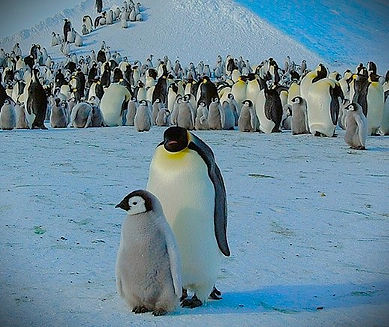
Her father said nothing. He just sat in his chair, staring at the dusty television set. The Lawrence Welk show was over now, its vaudevillian entertainments supplanted by a nature documentary about penguins. Penguins waddled single file across a desolate expanse of ice and snow. The camera closed in on a mother penguin, sheltering a fuzzy hatchling with one stiff black wing. Ivy got up from the couch, the plastic squeaking noisily as she did so. She felt sad that she really couldn’t love this man, that all she had to offer him was duty fueled mostly by guilt.
“Remember to take your pills,” she said, with a sigh. “I’ll see you again on Thursday and—”
“Wait,” her father said, raising his bony hand again and letting it drop. “I wanted to say something to you before you leave.”
“Yes?” Ivy said. She looked at herself in the smudged wall mirror that hung behind his chair, hating for an instant that she had the same milky blue eyes as her father, the same aqualine nose. “What?”
Her father grabbed her wrist and held it tightly. He looked up into her eyes.
“I just wanted to say…I just wanted to say…I’m sorry ‘bout the trash cans…”
Ivy shook her head. What the hell was her father talking about? Had he finally dropped forever into the land of senility?
Then, it struck her hard. She knew exactly what he was talking about. About five years ago, when she and Julie had started dating, when her mother was still alive and walking on the planet, raccoons kept getting into the plastic garbage cans that her parents had behind the house, strewing garbage everywhere, making a nightly mess. Julie had heard about this, and told Ivy that she knew of a place where they could get some empty fifty-gallon oil drums her parents could use as garbage containers, it would be no problem for her to pick them up and cart them over. Ivy had tried to relay this information to her father over the phone one night, expecting him to be happy with the solution. Instead, he had gone ballistic, and started screaming at her. “You are not going to turn my house into some kind of dive,” he had kept shouting over and over, until finally, embarrassed, she had hung up on him. At first, she had been mystified by his strange reaction, and then, it had finally dawned on her. He was angry not because there would be oil cans sitting in his back yard. He was angry because Julie was trying to do something for him, make a friendly gesture. Ivy hadn’t talked to him for months after that.
“I was wrong,” her father whispered. “I should have let you both bring those cans over.” He tried to get up out of the huge chair now, getting up to a crouch and then falling back into the vinyl chair. Something, something Ivy thought had been callused over a long time ago broke in her heart, and she felt tears welling in her eyes.
“It’s O.K., Daddy,” she said, going to help her father up so he could hug her for the first time in years. “It’s really O.K…
Michael Walker is a writer living in Newark, Ohio. He is the author of two published books: 7-22 and The Vampire Henry. He has also seen his stories and poems published in various magazines including Sky Island Journal, PIF, and The Adelaide Literary Review.


Comments