


Longlist Saturdays: Sharkskin by Bruce McAllister
- Jul 11
- 6 min read
When my father was stationed on that beautiful bay with its long, uninhabited peninsula, we lived in officer quarters on the base and would go on the weekends to the end of the peninsula when the lowest tides exposed vast tide pools. My grandmother, my mother’s mother, who lived with us, loved seashells, and so did my mother. They collected them from the tide pools and boiled them clean when we got home, so I did too. We did it together. It felt good. My father wasn’t interested in shells and, tough as he was, he’d instead sit high on the beach carving a piece of whalebone with a big knife.
My shell collection was growing, and I was very happy leaping from tide pool to tide pool like an athlete (which I definitely was not), judging quickly as I leaped which living things were in the tide pool and which weren’t: Giant Keyhole Limpets, Wavy Turbans, Kelp Turbans, the elegant Murex foliatus, Owl Limpets, Purple-hinged Oysters, four kinds of abalone, and so many others. Sometimes there was a dead seal, its eyes white, its belly bloated—and once even a rotting whale—but they were always on the sand high above the tidepools, where my father sat, and I ignored them.
On one trip, a Saturday morning earlier than usual (it was a minus 2.5 tide—which was rare and very exciting), we got to the tidepools at first light. I went off on my own (I was twelve), watching the rocks at my feet as I ran toward the biggest, deepest tide pool, my favorite, which was always there if the tide was low enough and which often had schools of fish or big, lone octopi “out for a walk,” as my grandmother used to say. How big? “At least ten meters across,” my dad announced when he saw it.
As I got closer, I realized something big was swimming in it, and swimming in circles.
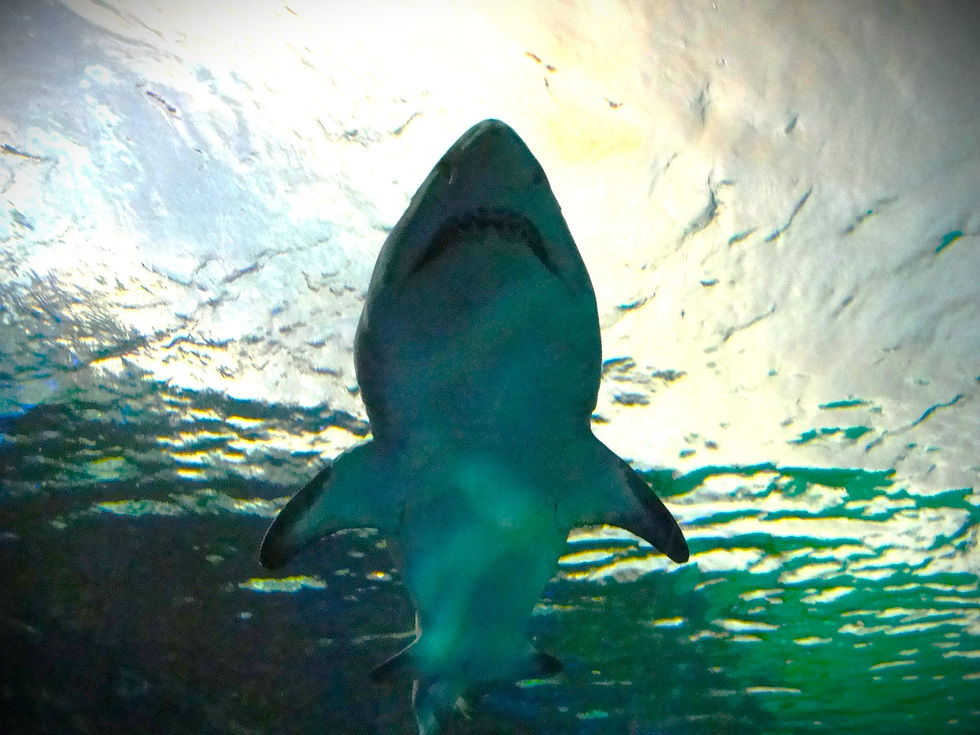
It was a shark. Not a small Leopard Shark but a bigger animal, long and lithe, big enough that the tide pool’s shallowness made it uncomfortable and it needed to stay near the surface. I didn’t know what species it was. My father had never caught one like it on the Navy base’s wharves in the bay.
The shark hadn’t known where it was in the darkness of night, hadn’t paid attention—eating the crustacea and octopi of the big tidepool perhaps. It had gotten caught by the outgoing tide.
Round and round it swam because sharks had to swim to breathe. It rolled once, like they do in a movie, a movie where the shark rolls and we see its eye and we feel evil in it. But I didn’t feel any evil. It rolled and I saw an animal that knew it was trapped in an ocean much smaller than an ocean should be, one that made it swim in circles so it wouldn’t suffocate.
As the sunlight grew stronger, I saw something strange on its side.
Was it scars from a fight with another shark or scrapes on rocks in a storm or something else? I couldn’t tell.
The more I looked, though—the closer I looked each time it passed by—the more the scars looked like writing, words carved into its skin. It wasn’t possible.
How could you carve words into a shark? How could you make it stay still?
When it rolled again, I recognized a word, an actual word, and I saw little blunt teeth in its jaws—the teeth of a child, as if someone had put a child’s teeth in it. But how could it eat what it needed to eat like that?
The word I’d seen was
LET
I held perfectly still. I waited for it to come around again.
When it did, I saw two more words—
THE CHILDREN
And when it came around, rolling one more time, a fourth word:
SING
What did it mean?
LET THE CHILDREN SING
Each time it passed, the water at its side looked pinkish, as if the words were bleeding.
I wanted to tell someone, but I also didn’t. It was for me, this message, I told myself.
If I shouted to my dad to come look at the shark, he might kill it. “To protect swimmers,” he always said even when it made no sense. He always had a spear gun in the car.
I didn’t want that. I would have a year ago, when I used to take the flat-bottom dinghy out from the Navy docks and pole through shallow water to the edge of the channel that separated the officers’ beach from the civilian yacht club. There, I’d spear ten or twenty rays or skates, because it felt good, because I was a hunter who’d killed so many with the spear I’d made. It was thrilling. I’d let them go after that because you didn’t eat rays and skates, but most would die, I knew.
I didn’t feel that way anymore. One day I’d speared a big, cow-spotted Angel Ray and, as I pulled it into my dinghy, it had babies on the floorboards. Little miniature versions of her, just like any babies you’d see—kittens and puppies—and all I could do was stare at them squirming on the floorboards. I didn't know what to do, and I finally pushed as many of them as I could over the gunnel along with the mother, who was heavy and who wouldn’t, I knew—because of where my spear had entered her, where she was bleeding—live.
After that, I stopped going out. I stopped hunting.
I didn’t mention the shark to my parents or grandmother. I stayed with my grandmother while she collected shells, and then we went home to boil and clean what we’d found.
I didn’t dream about the shark, but I thought about it a lot. I thought about it so much, in fact, that I couldn’t think about other things and didn’t get my homework done. My parents didn’t know about this until my grades arrived, and then they got worried. Not mad. Just worried.
“Is everything okay, Brad?” my mother asked over dinner.
“Yes. It’s just a girl,” I lied. “I—I think a lot about her.”
“Have you talked to her?” my mother asked.
My father jumped in: “Don’t encourage him, Sheila! He’s only twelve.”
Quietly my mom said, “Sometimes doing something else—anything—can make a person stop circling in their mind. Sometimes even something painful, like talking to a girl, can help.”
She knew this from her own life, I could tell. Once she got something in her head, it wouldn’t go away and it affected all of us. I’d talked to her a couple of times about this, or tried to, because even at ten or eleven I wanted to understand, but she didn’t want to do it. “Is it about the blood,” I asked once. She shook her head, not a “No,” but simply a “I don’t want to talk about it.”
I’d seen blood running down her leg, on the inside, once—she was humming her favorite song very quietly, as she always did—and when I’d asked my grandmother about it, she’d said only, “It’s her time of the month.”
It wasn’t. It was only ten, but I knew. It wasn’t that kind of blood.
I wanted to stop thinking about the shark, so I took a kitchen knife, a “steak knife” with its saw-tooth edge, and, though it hurt, I cut the shark’s words into my leg—high enough that my shorts and swimming trunks would hide them. It hurt, and it kept hurting when I was through. I had to bandage where I’d cut so the blood wouldn’t run down my leg. The words hurt, as if screaming to be heard, for about five days, and when the blood stopped and a redness remained, and later the scars appeared, I could look at them. I could touch them and feel closer to her—to my mother. It was important that someone do it for her.
I didn’t know what words she had on her legs, but I had mine.
Let the children sing, my fingers read, pronouncing them slowly.
I should cut them into my other leg, too, I knew—for everyone’s sake.
Bruce McAllister's short fiction has appeared in US national magazines, literary journals, and “year’s best” volumes; been translated into a number of languages; and won or been shortlisted for awards like the US National Endowment for the Arts, the Nebula, the Shirley Jackson, and the magazines NARRATIVE and NEW LETTERS. His most recent novel is THE VILLAGE SANG TO THE SEA: A MEMOIR OF MAGIC; his most recent short story collection is STEALING GOD AND OTHER STORIES.


Comments